
“Down From Dover” is a harrowing account of a young woman, pregnant with her first child and abandoned by everyone she loves, attempting to make sense of her life and what got her here. It is written in the voice of the female naif, a persona that the wider culture both reveres and ridicules for her supposed foolishness. The whole world tells you, when you are a young girl, that it’s run on set rules, and then laughs at you when you expect anyone with power over you to follow them. The naif is a very old archetype in literature, but she is usually approached with pity, or placed in situations of intense irony—there has to be an emotional distance for the reader, always assumed to be smarter than the naif, to be able to find her worthy of contemplation. I am thinking of Tess in Tess of the D’Urbervilles and Fantine in Les Miserables and the protagonist of Chekov’s The Darling. Women and girls who continue to act in good faith, even when the world around them has told them there is no such thing. Their innate character does not change, but the world around them does, and that is the motion of the narrative.
Dolly Parton’s “Down from Dover” is also about a naif, written in the voice of a girl who cannot believe she has been deceived until the bitter end. But Parton writes this character with respect, not merely sympathy.
I know this dress I’m wearing doesn’t hide the secret
I have tried concealing
When he left he promised me that he’d be back
By the time it was revealing
From the opening lines, we are in her point of view, and we see how she is a girl both acknowledging reality and desperately clinging to the delusion that her lover will return. She’s not dumb, she understands that everyone sees her pregnancy and her mistake, but she’s in a different reality than everyone around her, a sense of time that is dictated both by her lover’s words and by the natural world she uses to mark the passage of time. The next part of the verse is:
The sun behind a cloud just casts the crawling shadow
Over the fields of clover
And time is running out for me I wish
That he would hurry down from Dover
I want to stop here and talk about writing about a place. We are in a moment in American fiction where the fashionable writers are those who are decidedly anti-place, who seek to make a comment on our current reality by refusing to directly describe the worlds that characters move from. I’ve heard the arguments about how this is a comment on our current homogenized worlds, but I remain not entirely convinced. Shiplap in an AirBnB in Nashua, NH hangs slightly differently from shiplap in an AirBnB in Nashville and I think it’s the job of a writer to find out how to describe that difference, not throw up her hands and refuse to try. Art, by definition, is artifice, and it is through our descriptions of a world that we get at what it means to live in it. Nameless cities and amorphous streets may flatter a reader’s intellect but it doesn’t do much to move anyone, one way or the other. And you are in this profession to move people, whether you are brave enough to admit it or not.
Dolly was brave enough to admit to wanting to move you. “Down From Dover”’s craft is impeccable in part because it uses the cues of the natural world to tell us how the speaker’s pregnancy passed, and how long she has been waiting for her lover to return.
He’s been gone so long
When he left the snow was deep upon the ground
And I have seen a spring and summer pass
And now the leaves are turning brown
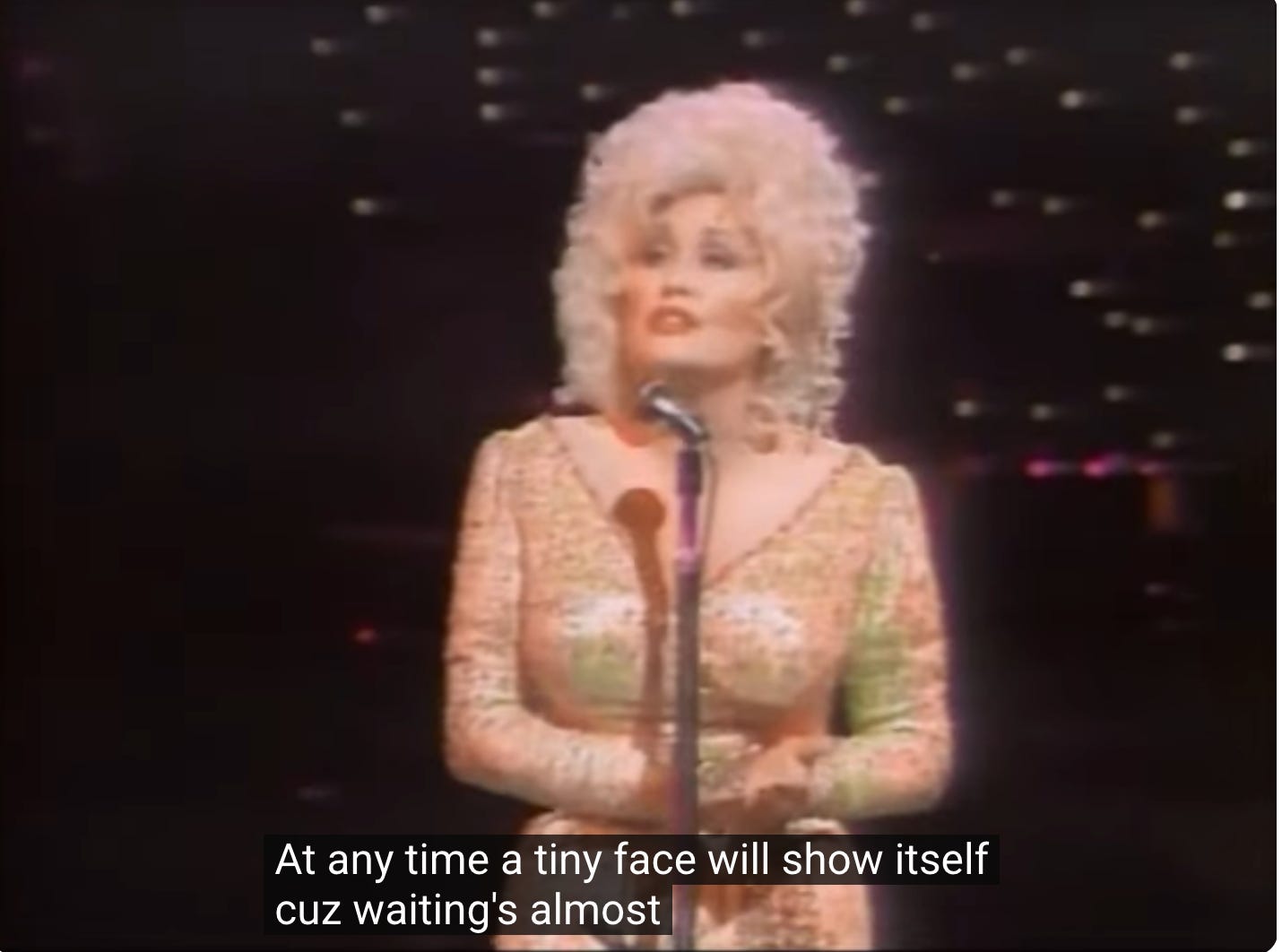
At any time a tiny face will show itself
Because waiting’s almost over
But I won’t have a name to give
It if he doesn’t hurry down from Dover
From Dover, from Dover
We understand a bit about who this girl is—that she lives in a place where she can see snow deep on the ground, that she can feel the season’s pass, and that she is in the limbo of expectant motherhood—when you can rhapsodize about your child’s “tiny face” but still can only imagine the baby as “it.”
There’s no chorus in “Down from Dover”, only the refrain of the titular phrase. I think Dolly does this to remind you of how alone the speaker is in this song—you, as the listener, can’t even offer the comfort of singing along. The next verse is all about her isolation
My folks weren’t understanding when they found out
They sent me from the home place
My daddy said if folks found out
He’d be ashamed to ever show his face
My mamma said I was a fool
And she did not believe it when I told her
That everything would be all right
Because soon he would be coming down from Dover
Instead of a chorus, you have to listen to her story all the way through—the only time you can chime in is on “down from dover”, which is less about giving reassurance or reminding you this is a song and more forcing the listener to enter into the same obsessive longing of the speaker in this song. Don’t even get me started on the image that echoes over from the previous verse, of the speaker anticipating her baby’s “tiny face” showing itself (notice how she avoids singing about labor, birth, effort, anything of her body helping that happen) and her father telling her “he’d be ashamed to ever show his face.”
Share
The next verse is an attempt of the speaker to explain herself. The naif in literature is there to be defiled, disabused of her innocence, but here, from her point of view, sex falls away from any of the harsh morality of literature and becomes a human thing
I loved him more than anything
And I could not refuse him when he needed me
He was the only one I’d loved
And I just can’t believe that he was using me
He couldn’t leave me here like this
I know it can’t be so, it can’t be over
He wouldn’t make me go through this alone
Oh he’ll be coming down from Dover
The final verse of the song is its most brutal.
My body aches the time is here
It’s lonely in this place where I’m lying
Our baby has been born but something’s wrong
It’s much too still I hear no crying
I guess in some strange way she knew
She’d never have a father’s arms to hold her
And dying was her way of telling me
He wasn’t coming down from Dover
The last four lines are too much, risk veering into the maudlin. But Parton, as a writer, earns this brutality because in the previous verses she has grounded this character so expertly in place, in space, in the logic of the bright one. This whole song is, in part, about a girl who cannot face reality, who cannot call anything by its name, who reverts to the near nonsense phrase “down from Dover” whenever her courage fails. But in the end, the speaker can finally name the worst of it: that her daughter is dead and maybe even chose her death rather than be abandoned. The character has changed after all. Not for the better materially—she’s alone, her baby is dead. But she can look at life plainly. The genius of the song is that it asks you if you can do the same.
Dolly Parton wrote “Down From Dover” as part of a trilogy of songs about womanhood. The others are “Daddy Come and Get Me” and “Just Because I’m a Woman.” I wrote about “Just Because I’m a Woman” and anti-Blackness and transphobia a few years back, here. Taken together, these three songs are fascinating to me. Dolly Parton has so many other novelistic songs— “False Eyelashes”, “Hard Candy Christmas”, “The Bargain Store”, the infamous “Robert” (a ballad about the horror of realizing you have fallen in love with your half-brother from the right side of the tracks because your mama was messing with the richest man in town). It always amazes me when people claim Dolly Parton was fluffy or light. This lady was dark as hell, and willing to look at the darkness and make art from it. May we all be able to do the same through this long, strange, very sad summer.
Love looking at Dolly's work in a writing craft lesson. Brilliant and spot on.
Love the focus on the importance of grounding a story in a physical place, its traditions, its oddities, its language. That also feels very much missing in arts (especially music, my corner) journalism. Specific spaces are where real (not virtual) things happen, where actual people physically interact, where community solidifies (or crumbles). I first learned the song on one of Dolly's bluegrass albums, on which it's played as a Scottish murder ballad, showing how place can be both exact and transferrable. Thanks for this great read.