Chocolate City

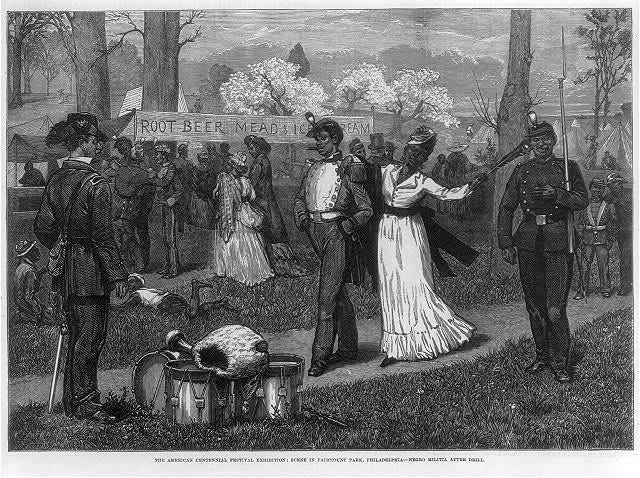
Right after slavery ended in the United States, thousands of Black people, formerly enslaved by white slave holders in the South, flooded Washington, DC. They breathed new life into the city, previously known for its literally stinking swamps. Black people were drawn to the ample amount of employment available in DC. Between Reconstruction and the 1910s, when Woodrow Wilson segregated federal employment and purged DC of its Black employees . This is the playbook DOGE cribbed from, whose efforts disproportionately fired Black federal workers. The federal government has always offered a pathway into the middle class for Black people. That is the reason conservatives have historically hated government employees so much. In DC in particular, the public schools also offered employment and a organizing staging ground for a growing Black educated class. DC public schools in particular were known as an employment safe haven for Black queer people at this time—look deeply into the biographies of any of the “race women” of that era (the term our communities used for Black activists), and you almost always find a fierce, dedicated teacher living alongside her “friend.” DC meant freedom to determine Black life, Black art, Black intellect, Black sexuality. It’s been a target ever since.
One of my favorite authors, maybe the best short story writer this country has ever produced, Edward P Jones, traces this whole history in his story “In the Blink of God’s Eye” in the collection All Aunt Hagar’s Children. The story begins, “That 1901 winter when the wife and her husband were still new to Washington, there came to the wife like a scent carried on the wind some word that wolves roamed the streets and roads of the city after sundown.” We watch as a young couple moves to a burgeoning DC, trying to make sense of this new world. There’s a throwaway line, about how a character wants a pearl necklace the emperor of Haiti brought to DC. Imagine my surprise, as an archival nerd, to recognize this was a real object–when I was researching my own novel about Haiti in the 1880s and 90s, I came across long cold gossip about Black DC elite vying with each other of who would host Haitian dignitaries on the country’s official diplomatic mission to a post-Civil War US, society biddies marveling at the emperor’s pearls. A plot point I wish The Gilded Age would consider covering. But then, that would require that show to acknowledge the complexity of Black thought and also a Black elite who were interested in Blackness. But I digress. This essay is not about strays for HBO.
All that Black beauty, elegance, freedom came with a price. Even as Black people moved to DC, white supremacists, that is to say, most white people in the United States at the time, viewed them as a threat. The number of Black people committed to insane asylums in the DC area skyrocketed post-Reconstruction. The likely reason–white people terrified of Black freedom and criminalizing anyone seen as different–was overlooked. Instead, a whole academic sub-industry sprung up that claimed Black people’s minds could not handle freedom. Liberation made us mad. This argument is deeply entrenched in every aspect of American intellectual life. You see traces of it in the aftermath of the Civil Rights movement, when young Black activists and protestors were often diagnosed with schizophrenia or other mental disorders when they encountered the state. The idea that you might protest Jim Crow was literally seen as evidence that you were crazy.
The idea that Black people cannot govern ourselves; that our governance will always be corrupt, tainted, wrong, and somehow even worse than what the worst white dictator could do, is deeply ingrained in America. It's believed not just by white people in the United States anymore–Black people, Asian people, Latino people believe this too. It’s why the Obama presidency–that staid middle ground of neoliberalism and escalating American violence abroad–is still painted as some sort of lunatic fringe of excess leftism on the right. It's why Biden is so hated. It’s not his policies–it’s his connection to, and strategic championing of, the Black political class that sustains self governance in the South and midwest. For the people who support this administration, Biden is a nigger lover–which, to a white supremacist, is worse than being Black.
This fear of Black freedom, and the assumption that our freedom must mean insanity and unruliness, is why Trump has called in the National Guard. Yeah, sure, distraction. But you have to understand: Trump’s distractions always double as a reiteration of his white supremacist beliefs. He will dither over the Smithsonian and the removal of Black names from buildings as a distraction, because those things feel good and right to him.
It should not be lost that every city he has signalled out for a takeover by the National Guard–Baltimore, New York, Chicago, Oakland and Los Angeles–are the major metropolitan areas currently administered by Black mayors. They are also centers of Black wealth and ownership. DC is a testing ground, yes, of whether Americans will tolerate the federal white supremacist takeover of cities run by Black powers. I don’t think a Black mayor is likely to be any better, materially, for Black people than a white one–we have 45 years, at this point, of the failure of Black mayors championing neoliberalism to see that. But that is beside the point here. To a white supremacist, the mere fact of these mayors makes them illegitimate.
Just tonight, one of our country’s fascists insisted “there are whole neighborhoods in DC, probably, that need to be emptied, need to be bulldozed.” He was not talking about Embassy Row, of course. He was talking about the Black neighborhoods that have sustained Black culture, organizing and power for 150 years.
A formative political memory of mine from childhood is watching George Bush, the first one (yes, I’m old), go on national tv and hold up a little baggie of white powder, claiming it was crack bought outside of the White House. (It ended up being a lie). This was how far DC had fallen, he claimed. This was the boogeyman of childhood in the 1990s–the inner city. If you were Black, you were constantly judged by how close you might be to it. To be close to it meant inherent degeneracy. If you are under thirty-five and reading this, I don’t think you can understand how blatant the class discrimination used to be against anything Black and working class in the 80s and 90s. I remember one of the only Black teachers I had in high school, a woman who ran the Black History museum in my city. She kept me after class one day. “You’re smart,” she said. “Even though your mom’s on welfare.” When I tried to protest, she amended, “I’m telling you you’re smart. You aren’t like them.” Them is a powerful force in American culture. Its one Americans do not ever want to let go of. In a country so vast, with so much potential for actual freedom, the spectre of them works as a check, an internal mechanism, so you don’t give yourself up to liberation.
The Black people who made DC–those people who, like the couple in the Edward P Jones short story–rode into town on a single wagon, watching the smoke billow over the river from Virginia–weren’t afraid of freedom. They ran headlong for it, looked for it in the iridescence of pearls worn by Haitian emperors. May we have their courage in the coming days.